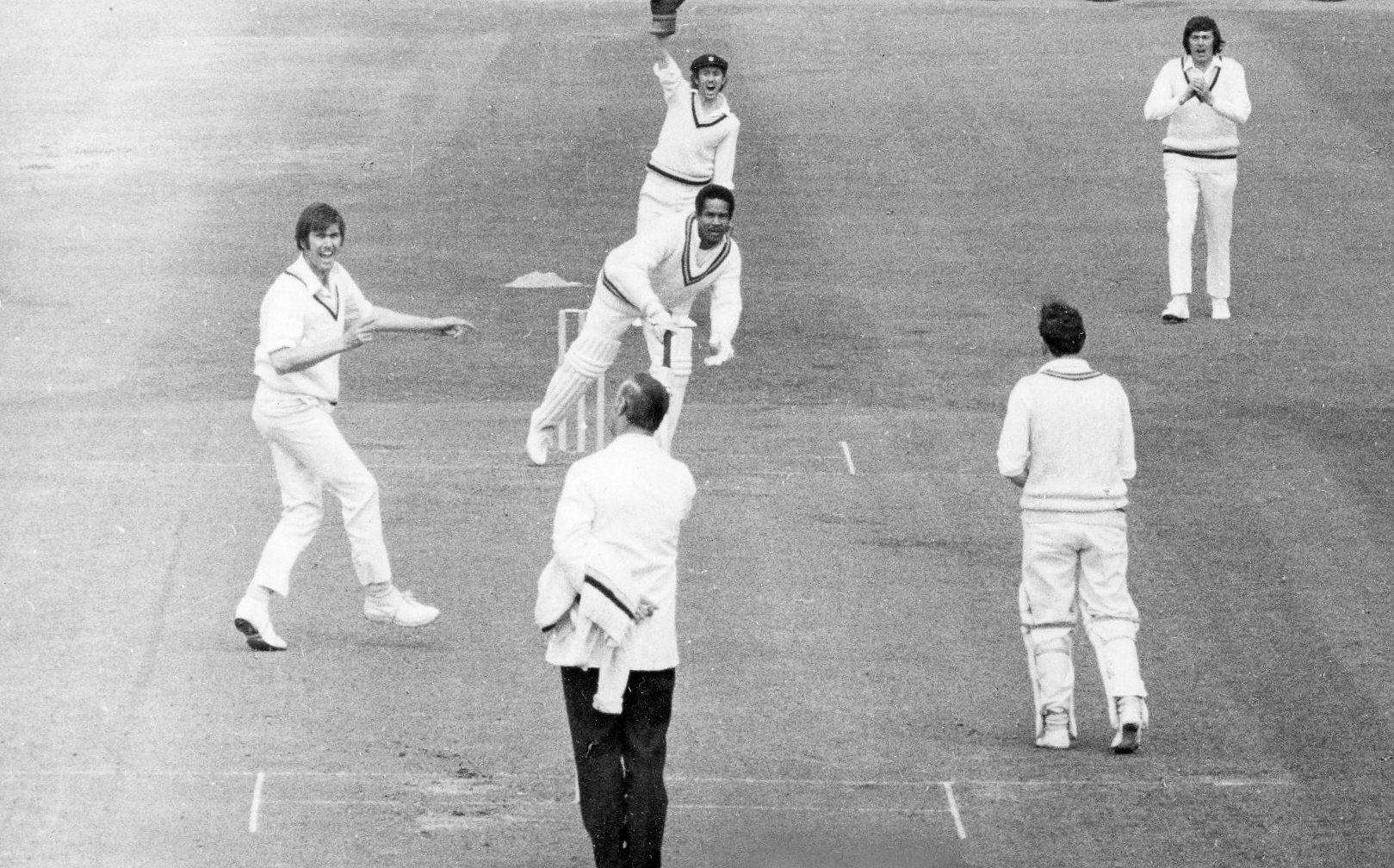
Derbyshire County Cricket Club is deeply saddened by the news of the death of fast bowler Alan Ward, a leading member of the county side between 1966 and 1976.
Heritage Officer David Griffin looks back at the cricketing life of Alan Ward.
Alan Ward was part of the great lineage of Derbyshire pace bowlers which began with Bill Mycroft, Bill Bestwick and Arnold Warren in the late Victorian era and was continued by Bill Copson, George Pope, Cliff Gladwin and Les Jackson either side of the second World War.
Harold Rhodes preceded Ward as a Test match cricketer for England ten years before Ward himself made his debut for his country ahead of his pace bowling partner, Mike Hendrick.
Devon Malcolm, Dominic Cork and Phil DeFreitas followed their predecessors into the England Test match side meaning that 11 Derbyshire cricketers have opened the bowling for England in Test match cricket.
Alan Ward was born at Dronfield on 10th August 1947 and was introduced to the Derbyshire members in the 1965 Year Book as “…a right arm fast-medium bowler…”
Tall and raw-boned, with a smooth run up to the crease and a high flowing action, he first came to the attention of the county club following several fine performances for Prestwich Works in 1964 which included seven for 29 against New Whittington.
He was invited to trial at Derby in late 1964 and appeared in a couple of 2nd XI and Club and Ground matches without any noticeable success, but it was noted that he had the ability to bowl quickly and he secured a further invitation to trial at Sheffield United Cricket Club where he came under the watchful eye of George Pope, a magnificent all-rounder who played in the 1936 Championship-winning team.
Ward made his Derbyshire debut in May 1966 against Essex in a low-scoring game at Ilkeston. Essex were dismissed for 95 in 63 overs and while the bulk of the bowling was completed by Ian Buxton and Harold Rhodes, Ward bowled six overs and took one wicket for 13 runs, that of opener Gordon Barker.
Wicketless against Oxford University in July, he played four further matches in 1967 with moderate returns and didn’t feature again until August 1968 when he appeared fitter and faster.
In four games, all of them in August, Ward took 26 wickets at an average of 11.84 with six for 56 and four for 38 against Glamorgan at Cardiff and five for 50 against Hampshire at Derby.
On the county cricket circuit, small and closely-connected, word soon went around that Derbyshire had the quickest bowler in the country on their staff and in 1969 his 16 first class games brought 57 wickets at 13.55 and the award for the Cricket Writers’ Club Young Cricketer of the Year. He also received his county cap.
Test honours came his way in late July 1969 when he was selected to face New Zealand at Lord’s where he took two for 49 and two for 48 as England won by 230 runs.
His best Test figures came in the next match at Trent Bridge when he took four for 64 in the tourists’ first innings of a high-scoring draw and he was retained for the final match at The Oval, and although England won by eight wickets, he bowled only five overs in the first innings and was the sixth bowler used in the second, when he took two for 28 off 18 overs.
In 1969 Derbyshire reached the Gillette Cup final after a remarkable victory in the semi-final over Sussex in front of more than 10,000 spectators at Chesterfield. Derbyshire made 136 all out from 54.4 overs and then let loose their pace bowlers, Ward, Rhodes, Fred Rumsey and Peter Eyre. Sussex made a mere 49 all out in 35.2 overs as Eyre famously took six for 18, although Ward began the rout removing Lenham and Cooper for ducks and finishing with two for 11 off eight overs, five of which were maidens.
In 1970 Ward became the first bowler in the world to take four wickets in four balls in a limited overs match, a feat unequalled until 1996 by Shaun Pollock.
The John Player League game against Sussex at Derby was played in early June with the visitors opting to bat first having won the toss. Ward took wickets with his 5th, 6th, 7th and 8th deliveries, ending with five for 11 off eight overs.
On the previous day, the opening day of the Championship game against the same opponents, at Buxton, Ward had demolished their batting line up with six for 30. In the space of two days against the same county on different grounds he took 11 wickets for only 41 runs.
Two more fifty-wicket seasons followed for Derbyshire in 1970 and 1971 and a further Test match against Pakistan but injuries began to take their toll and he returned home early from England’s successful Ashes tour of 1970-71 and much publicity centred on him being sent from the field by his captain Brian Bolus in 1973 for refusing to bowl against Yorkshire at Chesterfield.
Much has been written about that incident over the intervening years and it’s reasonable to reflect now that the matter would certainly be dealt with differently today and perhaps could have been even then.
Mike Carey explained the situation in the 1977 Year Book thus: “…Ward emerged at a time when lines of communication between committee and dressing room were fuzzy, and played under a series of captains who, because of other problems, perhaps never had the time to help Ward’s talent to mature…”
Nonetheless, Ward’s pace remained a potent threat when he was fully fit and I recall a terrifying spell against Essex in the John Player League in 1976 on a distinctly average pitch at Ilkeston when after four relatively innocuous overs had produced 10 runs, he returned to take six for 14 in his final four overs.
He was recalled to the national side to face the mighty West Indies side in 1976 at Headingley taking two for 103 and two for 25 and made a 47-minute duck for which he received a standing ovation as his batting partner, Tony Greig attempted to secure a memorable win for his side. The West Indies, however, prevailed by 55 runs.
At the end of that summer, Ward was released and he joined Leicestershire playing 22 first class matches for them and taking 37 wickets.
Ward’s overall record for Derbyshire is hugely impressive; 348 first class wickets at an average of 21.56 and a further 122 in one day matches at an average of 24.35 and perhaps with the fitness regimes in place today he might have played more matches and for longer. On the other hand, maybe the raw pace for which he was renowned might have been compromised.
For Derbyshire followers in the late 1960s and the 1970s, however, the sight of Alan Ward, smoothly approaching the crease before letting loose a delivery of high pace will remain one of the most thrilling recollections, for when he got everything right, there was no finer sight.
Alan, who lived with his wife Helen in Queensland, Australia since 2001 has three children, one of whom still lives in Derbyshire, and six grandchildren.
Everyone connected with Derbyshire County Cricket Club would like to extend their condolences to Alan’s family and friends.
Thu 8th October 2026
Wed 7th October 2026
Mon 5th October 2026
Fri 2nd October 2026