Derby’s best fireworks display returns to The OurCoop County Ground across Friday 6 and Saturday 7 November! Tickets selling fast. Book now!

As another T20 Vitality Blast competition reaches its conclusion, Heritage Officer David Griffin reviews Derbyshire’s campaign.
A plethora of words have been used to describe Derbyshire’s T20 cricket this summer, but ultimately, as the dust settles, the phrase ‘fine margins’ might best be used in the final analysis of their 12-match group stage.
Three wins, two ties and seven defeats is a sub-standard return when some of the individual efforts are considered, but only two of the defeats could be classed as particularly decisive; the 27 runs reverse against Somerset at Derby and the five wickets loss to Essex at Chelmsford.
The remaining losses were by four, five, six and ten runs and by two wickets. All could – arguably, should – have been wins, but the fine margins which often come into play in all forms of cricket – and the wider sporting world – just didn’t favour Derbyshire.
The six team group model was re-introduced in an effort to cut down on back-to-back matches and travelling time, although the final week of the competition saw Derbyshire playing on Monday, Wednesday and Friday evenings and Sunday afternoon, at Old Trafford, Derby, Chester-le-Street and again at Derby, respectively – not really the schedule players, in particular, and all other interested parties, especially spectators, had hoped for.
Each team played twelve fixtures in their group by playing each other twice plus two ‘cross pool’ matches, which for Derbyshire meant a trip to Chelmsford to face Essex and a match at Derby against the 2025 T20 champions, Somerset. Both matches were lost.
The weather was superb throughout with all Derbyshire’s games played in warm, often exceptionally hot conditions with not a drop of rain in sight. Little surprise, therefore, that outfields were like lightning and with dry pitches scores were largely on the high side.
The hitting at the start of the innings went to new levels in 2026 with 11 of the 12 matches recording combined powerplays of more than 100 runs; and the one that did not reach three figures was 99 against Durham at Chester-le-Street.
Home supporters were treated to a feast of runs as 2,435 runs were scored across the six games staged at Derby and Chesterfield – an average of over 400 runs per match – with 122 sixes – an average of 20 per game.
And paradoxically, despite the lowly points return, Derbyshire had a better overall record of 2,286 runs for 84 wickets than the combined efforts of their opponents who totalled 2,236 runs for 90 wickets.
The win-drought at Derby of 2025 was eclipsed when Nottinghamshire were put to the sword in late May, Derbyshire racking up 234 for four with Aneurin Donald and Martin Andersson adding 112 for the first wicket in 7.4 overs. This was a new innings record total in T20 cricket for Derbyshire as was the match tally of 28 sixes with Derbyshire hitting 16 of them.
But the eight game winning streak against Yorkshire at Chesterfield ended when Matthew Revis struck an improbable 17 runs off Akif Javed’s final over to ensure the game was tied.
However, the match against Lancashire at Old Trafford was arguably even more dramatic as the home side, requiring 13 off the final six balls and nine off the last three, hit two fours off the fourth and fifth (legal) deliveries of the over leaving just one to win off the final ball.
However, Nick Potts, charging in from the pavilion end clean bowled Matty Hurst to bring about Derbyshire’s second tied game of the summer; only Derbyshire’s fifth tied T20 game and 2026 was the first time that two had occurred in the same season in this form of the game.
With five players scoring more than 250 runs for the first time in a T20 season and seven bowlers taking 10 wickets or more – the previous record was five bowlers – it left many observers scratching their heads at Derbyshire’s failure to turn the good individual performances into a winning team effort.
Five players made a total of 12 half centuries as Martin Andersson and Aneurin Donald did the heavy lifting with four apiece while Matthew Montgomery made a couple and Caleb Jewell and Wayne Madsen one each.
Only in 2017, 2019 and 2022 have two Derbyshire players managed four scores of fifty or more in this competition and the reward in each of those seasons was a quarter final berth.
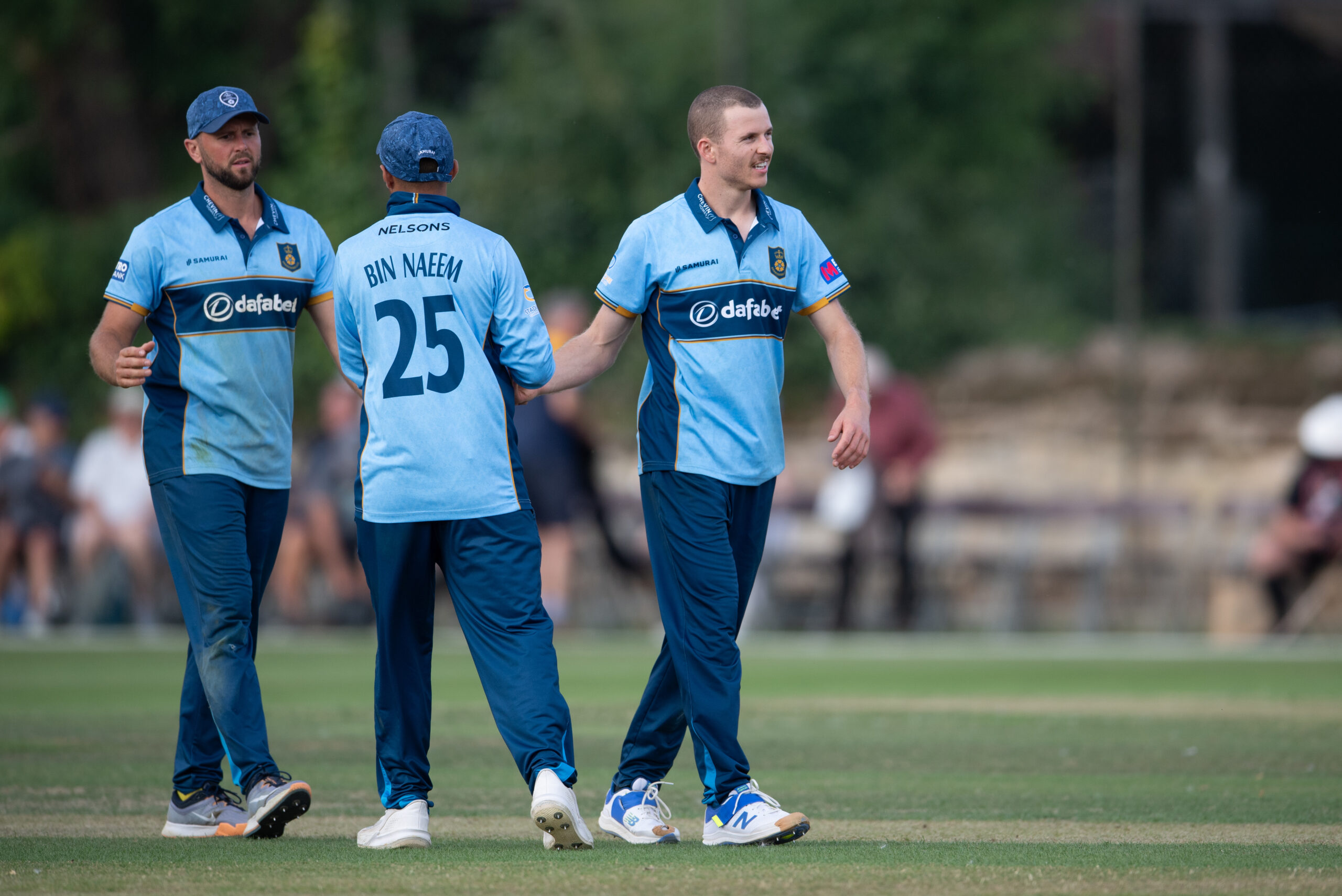
Akif Javed, one of three overseas players to appear in the Derbyshire side – the others were Jewell and Sufyan Moqim – was the leading wicket taker with 18 including two four wicket hauls, both of which came at Derby.
Andersson and Jack Morley also took four in a match meaning that for the first time in 24 years of T20 cricket there were four instances of bowlers taking four wickets in a game. Andersson finished with 11 wickets and Morley 10.
Potts, probably not expecting to feature when the season began, was selected in the absence of Pat Brown and Zak Chappell and took 16 wickets and looked useful with the bat too, while Montgomery and Moqim both took 10.
Andersson produced a memorable and remarkable all-round effort against Leicestershire at Leicester where he scored 57 when Derbyshire batted first and followed it up with six for 23. It was only the sixth instance worldwide in this format of the game of a player scoring a half century and taking six wickets in a match and his six wicket haul is a new Derbyshire match record.
Only six players have scored 250 or more runs and taken 10 wickets or more in a T20 season for the county and for the first time two did it in 2026, Andersson coming second in the individual scoring charts with 398 runs, plus 11 wickets, while Montgomery scored 273 runs and took 10 wickets.
Unsurprisingly, six hitting was to the fore with Derbyshire’s players clearing the boundary rope on 91 occasions. The overall total was eight fewer than in 2025 and five fewer than in 2023 but both of those totals were reached in 14 games. The opposition racked up 110 sixes in reply.
Derbyshire struck an average of 7.58 sixes per match this year – a new club record – as was the combined match average of 16.75 sixes per game.
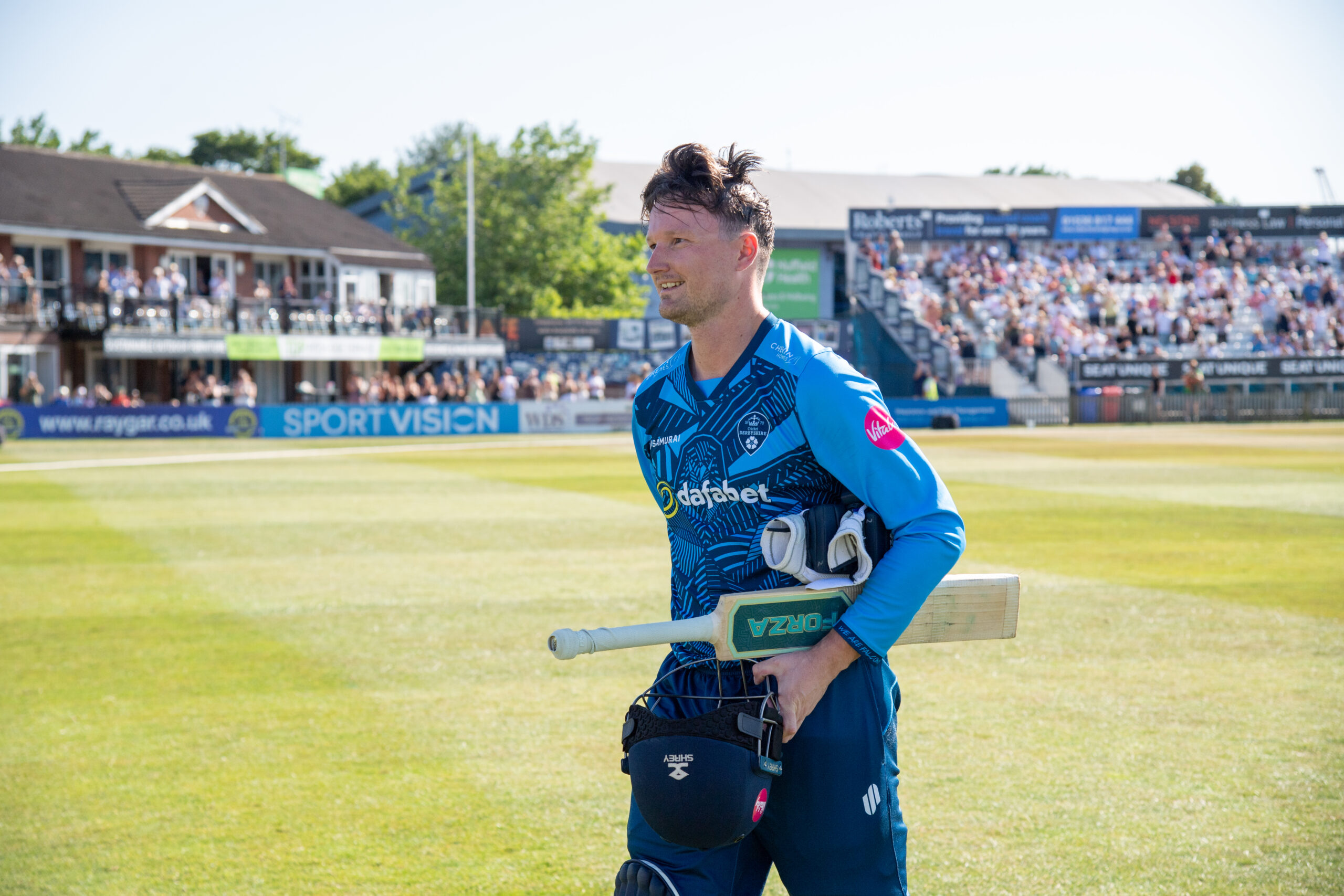
Wayne Madsen bowed out of domestic T20 cricket having made 190 appearances and scored over 5,000 runs. He has been Derbyshire’s outstanding T20 cricketer and leaves behind him an abundance of records and great memories in the short form of the game and it is quite possible that we may never see his like again at Derbyshire.
However, if the baton is to be passed to anyone, it is most likely to be handed to Aneurin Donald.
Captaining the side and keeping wicket in all 12 matches he scored 489 runs at an average of over 40 and a strike rate above 230. Of other players who passed 400 runs, the next two highest strikers were Kiran Carlson at 195 and Adam Lyth 180.
In the last four matches at Derby, Donald scored 84, 88, 65 and 91 for an aggregate of 328 runs off 133 balls with 27 sixes and 27 fours.
As Madsen retires with a club record of 114 sixes at a rate of 0.60 per innings, then surely Donald will overtake him next summer. He’s currently hit 93 sixes for Derbyshire at an average of 2.44 per game.
Many observers were impressed when Madsen set a new club record of 20 T20 sixes in 2023 but in the ensuing three seasons Donald has struck 23, 31 and now 37.
Donald only failed once to reach double figures as he racked up his 489 runs, the fifth highest individual runs aggregate for the county and the most by a wicketkeeper, soaring past the 243 scored by Gareth Cross in 2014.
Donald has also now scored ten of the 15 fastest T20 fifties for the county including the six fastest. He is truly a generational talent and it is such a pleasure to see him playing for Derbyshire.
So, after a lengthy list of highlights, records and strong individual performances, the failure to qualify for the knock-out stage is frustrating and comes back to the fine margin defeats and tied matches which effectively characterised the whole campaign.
On the other hand, opposition teams will argue that they held their nerve at the crucial time, that their players produced landmark performances to see their side home – Yorkshire at Headingley springs to mind – and that they should have won the two tied matches.
But six of the eight quarter finalists play in the first division of the County Championship which is maybe an irrelevance, but the top tier counties tend to have more resources at their disposal and it is therefore perhaps no surprise that the knockout stages are dominated by those sides.
In fact, 31 of the 40 quarter final places in the five seasons 2022 to 2026 have been taken by counties which ply their trade in the first division of first class cricket.
On the other hand, Northamptonshire, a second division Championship side, won nine matches and topped a Central & West Group which included two heavyweights in Somerset and Warwickshire.
Regardless, the competition ended on a high note with an emphatic win over Leicestershire with Donald very much to the fore and a fond farewell to Madsen, and the emphasis now shifts to the forthcoming Metro Bank One Day Cup competition followed by the remaining six County Championship matches.
In time, though, the focus will soon be on 2027 and a replacement in this format of the game for that man Madsen.
Tue 13th October 2026
Mon 12th October 2026
Thu 8th October 2026
Wed 7th October 2026