Get summer sorted with a Derbyshire Membership or Falcons Blast Pass.
Find out more and book now.
The OurCoop County Ground is presently undergoing a transformation with the installation of a completely new outfield with attendant drainage and irrigation systems together with state of the art LED floodlights.
Around £3 million is being spent to produce a top class playing surface with floodlighting which will be as good as any on the county circuit.
In a series of three website articles, Heritage Officer David Griffin will chronicle the multitude of ground developments since the first games of cricket were staged at Derby in the 19th century.
This series continues with this second part covering the period from 1955 until the end of the 20th century.
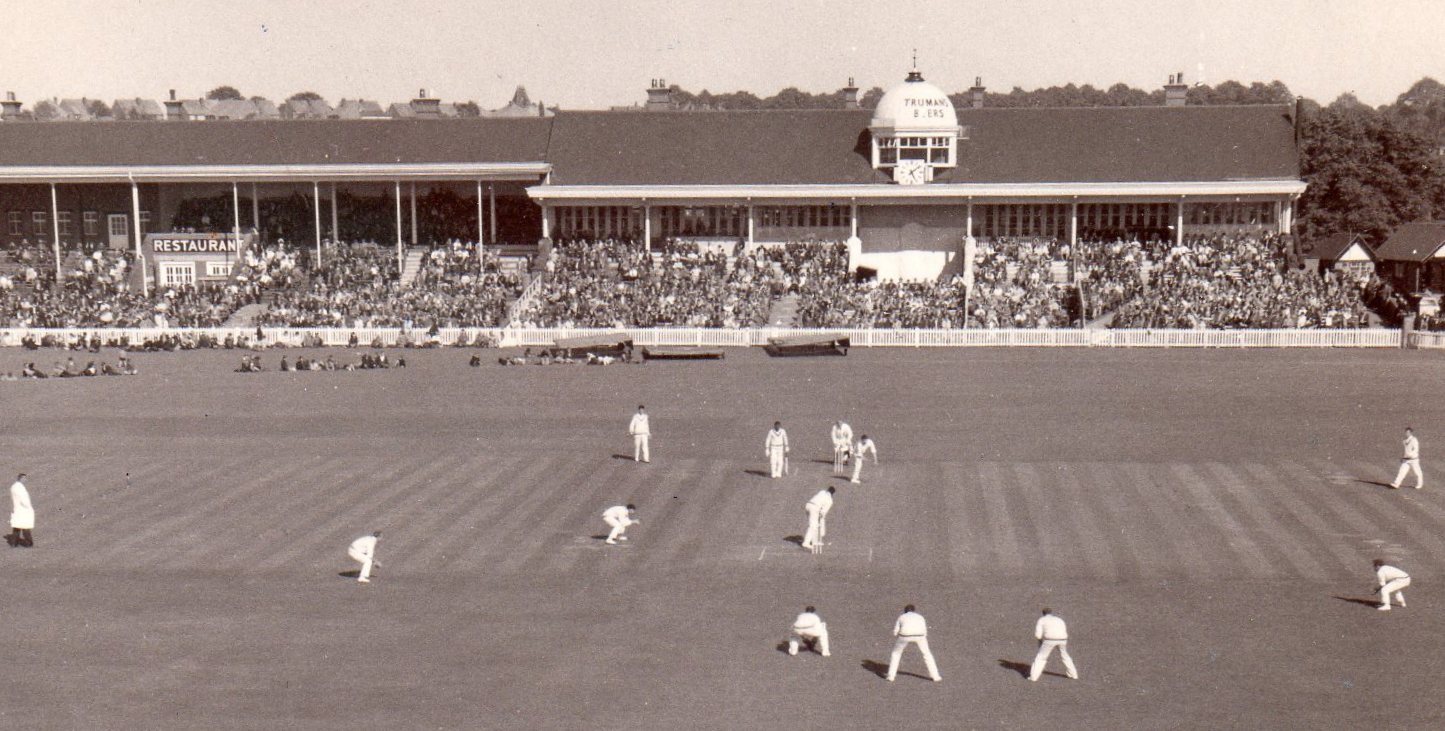
Ten years after the end of World War II Derbyshire relocated from their western site on the racecourse to the position we all associate with cricket being played today.
The local authority had taken ownership of the entire racecourse and Derbyshire sought to utilise the facilities formerly at the disposal of the racing community.
The Grandstand Hotel was still used by occasional paying guests and included bars and a ballroom amongst other amenities, but the Jockey’s Quarters and Judge’s Box had been eyed up by the Derbyshire cricketing authorities for some time. The original wooden pavilion was 70 years old in 1954 and no longer really fit for purpose.
Sadly, by this time, nor were the Jockey’s Quarters of a standard required as dressing rooms. They offered no view of the pitch and had spartan facilities and décor.
The shambling old building did provide some office space for the Club Secretary – who did have a view of the pitch – and the Judge’s Box was made available as a viewing area for players during games.
A concrete stand had been erected in 1939 to serve the old ground. By the time the new ground was opened, this stand no longer served any purpose for spectators although the underneath offered storage for the groundstaff.
A new square had been laid out by Head Groundsman Walter Goodyear over the course of several years and a two lane indoor school was erected behind where the modern pavilion now stands.
A scoreboard was built on the western side of the ground. Demolished three winters ago this provided space for the scorers too.
The ‘new ground’ as it was grandly described, offered 3,000 seats for spectators on the open Grandstand Terrace – and further back under cover – plus two press boxes.
The opening match began on 11th May when the South African tourists were the visitors and the Duke of Devonshire formally opened the ground and welcomed the players of both teams.
Play was on the now-familiar north-south axis until 1964 when, as a result of member complaints about having to watch cricket from a side on position, the square was rotated ninety degrees.
There were limited spectator facilities other than the Grandstand seating and so views behind the bowler’s arm were restricted to the handful able to jockey for position at ground level.
And so, from 1964 until the end of 2009, cricket was played on an east-west axis at Derby with only Lancashire, of the other counties, operating in similar fashion.
The ground remained undeveloped until the 1980s, although a significant tree plating exercise took place in the early 1970s to give the northern – racecourse – side of the ground a more pleasing look.
Derby County Football Club’s manager Brian Clough was invited to plant a tree as part of the initiative.
Unfortunately, in 1975, failure by the club and Derby Borough Council to reach agreement on the annual tenancy fee saw Derbyshire decline to play any first team cricket on the ground.
The offices remained in situ but all cricket after early May 1975 through to the start of the 1977 season was played in Burton, Buxton, Chesterfield, Darley Dale, Heanor, Ilkeston and Long Eaton.
Derbyshire had become cricketing nomads and there seemed no end in sight through the long hot summer of 1976.
A rapprochement was sought and found during the winter of 1976/77 and cricket returned to the ground just in time for Derby to gain city status as part of Queen Elizabeth II’s Silver Jubilee year.
In the late 1970s the bank was created in front of the tree line on the racecourse side of the ground. Members, including this writer, were invited to the ground in order to ferry wheelbarrows filled with soil to create the bank. The idea – apparently – was to try and hold back the northerly winds which occasionally flow down the racecourse, but this attempt to hold back nature was always doomed to fail.
Major matches, such as the 1969 and 1975 Gillette Cup semi finals had been staged at Chesterfield as had many crowd-pleasing tour games, particularly against the Australians and West Indians, while in 1977 over 11,000 spectators crammed into the Ilkeston ground for a Gillette Cup quarter final match against Somerset.
But in 1978 Derby hosted both the Benson and Hedges Cup quarter and semi finals and a semi final again in 1979 and it was clear that the general committee was looking to play more cricket in Derby and to develop the ground to suit that ambition.
Derbyshire’s NatWest Trophy win in 1981 prompted the building of the pavilion, known then as the Cavendish Pavilion.
At a cost in the region of £120,000, the pavilion provided new facilities for players, umpires and scorers on the ground floor with an upper room designed for use by corporate guests.
This was a significant turning point for the ground. In the latter part of 1980 there had been furious debates within the club management about whether or not to stage all cricket played at Derby. A committee vote saw a proposal to play all home matches at the County Ground supported by eight votes to three.
Rows ensued between the Chesterfield and Derby factions within the club until a deal of sorts was announced which saw a limited amount of cricket played at Chesterfield but with Derby now clearly the venue of choice for the county.
Crowds in excess of 6,000 attended the NatWest Trophy wins in the quarter final over Nottinghamshire and the semi final against Essex and ten days after the final win at Lord’s the Member of Parliament for Derby told the Derby Telegraph: “Derby must be one of the shabbiest grounds in the country” and “We shall never get a better moment than now to invest in improvement”
The pavilion delivered some improvement and subsequent extensions supported by donations and loans, including from Mr Harry Lund, after whom the pavilion was subsequently named until well into the 21st century, doubled the amount of floorspace on both levels of the building.
At the end of 1984 the landscape of the western side of the ground changed as the old concrete stand was demolished and a new scoreboard built. This latter building is now used as a compound for grounds equipment and quarters for the groundstaff.
Within two years the Tea Bar and two stands had been built, one at what is now the City End and the other in the south-west corner which remains, now with a roof on.
The Tea Bar building morphed into the Ladies Tea Bar staffed by volunteers for many years before most retired on age grounds and the club took over the running of it.
It was split in half in 1990 in order to accommodate the Club Shop which itself relocated several times in the ensuing 30 years.
If you look closely at the building you will note that there are pillars in each corner which are designed to be weight-bearing; the original idea in 1986 was to add tiered seating on top of the building.
At that stage, ground development was over until the tail-end of the century although towards the end of 1993 the club announced plans to buy the Grandstand Hotel. The property had declined in appearance and popularity over the years, although the main bars were still very popular on matchdays. The Ministry of Agriculture, Fisheries and Food had taken up residence in office space at the southern end of the building but otherwise, the glory and glamour of dinners and dances had long gone.
On the terrace at the front of the building, the old wooden benches had given way to plastic tip-up seating and some of the concrete terracing was upgraded, but that was all.
On 12th June 1998 the Grandstand Hotel closed its door as Banks’s Brewery put the ‘For Sale’ signs up.
Consternation ensued within the club as the hotel and surrounding land, including a ‘ransom strip’ to the front of the terrace which extended some 12 yards onto the playing area, were for sale as freehold property.
Derbyshire could scarcely afford for the property to be purchased by a third party and so offered the full asking price of £365,000 and succeeded in becoming property owners for the first time in their history.
The fate of the hotel will be discussed further in the final part of this series.
On the field, the 40-odd years which cover this period, saw Derbyshire’s fortunes rise, falter, rise once more and then plateau.
Post-1955, Derbyshire cricket was fortunate to call on some of the leading players in the club’s history – Cliff Gladwin, Les Jackson, Derek Morgan and Edwin Smith all took one thousand first class wickets, while Harold Rhodes came close.
Lacking a truly high class batting line up, the bowling – as magnificent as it was – couldn’t alone take Derbyshire to the county title despite several close efforts in the late 1950s and 1960s.
Jackson, Derbyshire’s all format leading wicket-taker with 1,672, took 367 of them at Derby including 27 five wicket hauls, but for many Derbyshire cricketers up until the late 1980s, opportunities for significant aggregates of runs and wickets were limited because of the plethora of outgrounds on which they played their home cricket.
For instance, between 1921 and 1981, more first class cricket was staged at Chesterfield than at Derby.
Opposition players nonetheless enjoyed themselves at Derby, with Richard Johnson producing one of the most memorable efforts in taking all ten wickets – for 45 runs – in Derbyshire’s second innings, the best innings figures at the ground.
Three years earlier, David Millns had taken nine for 37 for Leicestershire while in 1995 Dominic Cork recorded figures of nine for 43 against Northamptonshire.
Kim Barnett, Derbyshire’s most successful cricketer made 136 first class appearances at Derby and 152 in List A cricket and scored 8,345 first class runs and 5,113 List A runs with 27 all format centuries – all records on the ground.
Behind the wicket, Bob Taylor produced a club record of 280 first class dismissals en route to becoming the world record holder, a title he still holds.
In the era of overseas players, begun in 1968, although shunned by Derbyshire until 1970, the County Ground bore witness to some of the finest players of their age wearing the rose and crown.
Mohammad Azharuddin, Eddie Barlow, Michael Holding, Peter Kirsten, Dean Jones and John Wright remain in the front rank of Derbyshire overseas cricketers with their many exploits still fondly remembered today.
Memorable games came thick and fast as Derbyshire won the NatWest Trophy in 1981 with a splendid win over Nottinghamshire at the quarter final stage and then a last ball thriller against Essex in the semi-final.
In 1993, Derby hosted the Benson and Hedges Cup semi-final against Northamptonshire in front of a crowd in excess of 5,000 on a blisteringly hot day. The comprehensive eight wicket win was beyond the wildest dreams of most Derbyshire supporters.
But for sheer drama, winning the Refuge Assurance Sunday League with a victory over Essex in late August, 1990 in front of 11,000 spectators probably trumps even those earlier victories.
As the 1990s ended, the side which had prospered in those one day competitions and finished second in the County Championship under the captaincy of Dean Jones in 1996, had largely broken up.
As the new century beckoned, so did two divisions, a new short form competition and a raft of changes on the ground. More will be revealed in the final instalment.
Mon 16th November 2026
Mon 16th November 2026
Fri 13th November 2026

Wed 11th November 2026

