Derby’s best fireworks display returns to The OurCoop County Ground across Friday 6 and Saturday 7 November! Tickets selling fast. Book now!
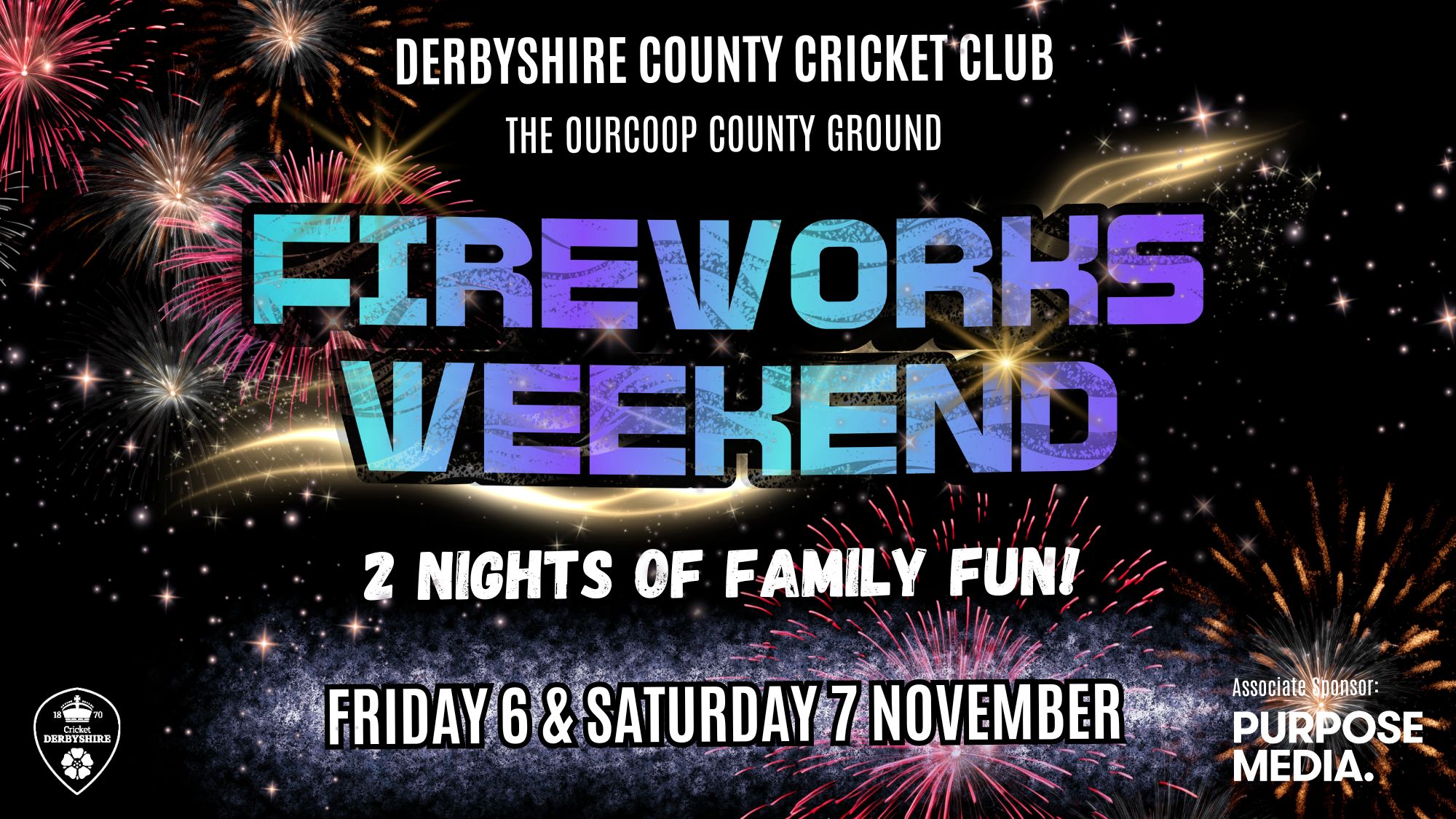
The OurCoop County Ground is presently undergoing a transformation with the installation of a completely new outfield plus drainage and irrigation systems together with state of the art LED floodlights.
Around £3 million is being spent to produce a top class playing surface with floodlighting which will be as good as any on the county circuit.
In a series of three website articles, Heritage Officer David Griffin will chronicle the multitude of ground developments since the first games of cricket were staged at Derby in the 19th century, as well as adding some statistical flavour.
This first piece covers the period from 1868 until 1954.
What is now known as The OurCoop County Ground was initially a racecourse. Established in 1847, the Derby Racecourse was very popular, hosting all-year-round racing on the flat and over the jumps with cricket first being played on the site in 1863 when South Derbyshire Cricket Club, forerunner of Derbyshire County Cricket Club, faced a Rugby School side on a pitch located in a similar position to the current one.
The South Derbyshire club also played the touring Australian Aboriginals in 1868, a game which produced the earliest-known image of cricket at the ground, while in 1871 – following the club’s official formation in November 1870 – Derbyshire played their first first class game on the ground, against Lancashire.
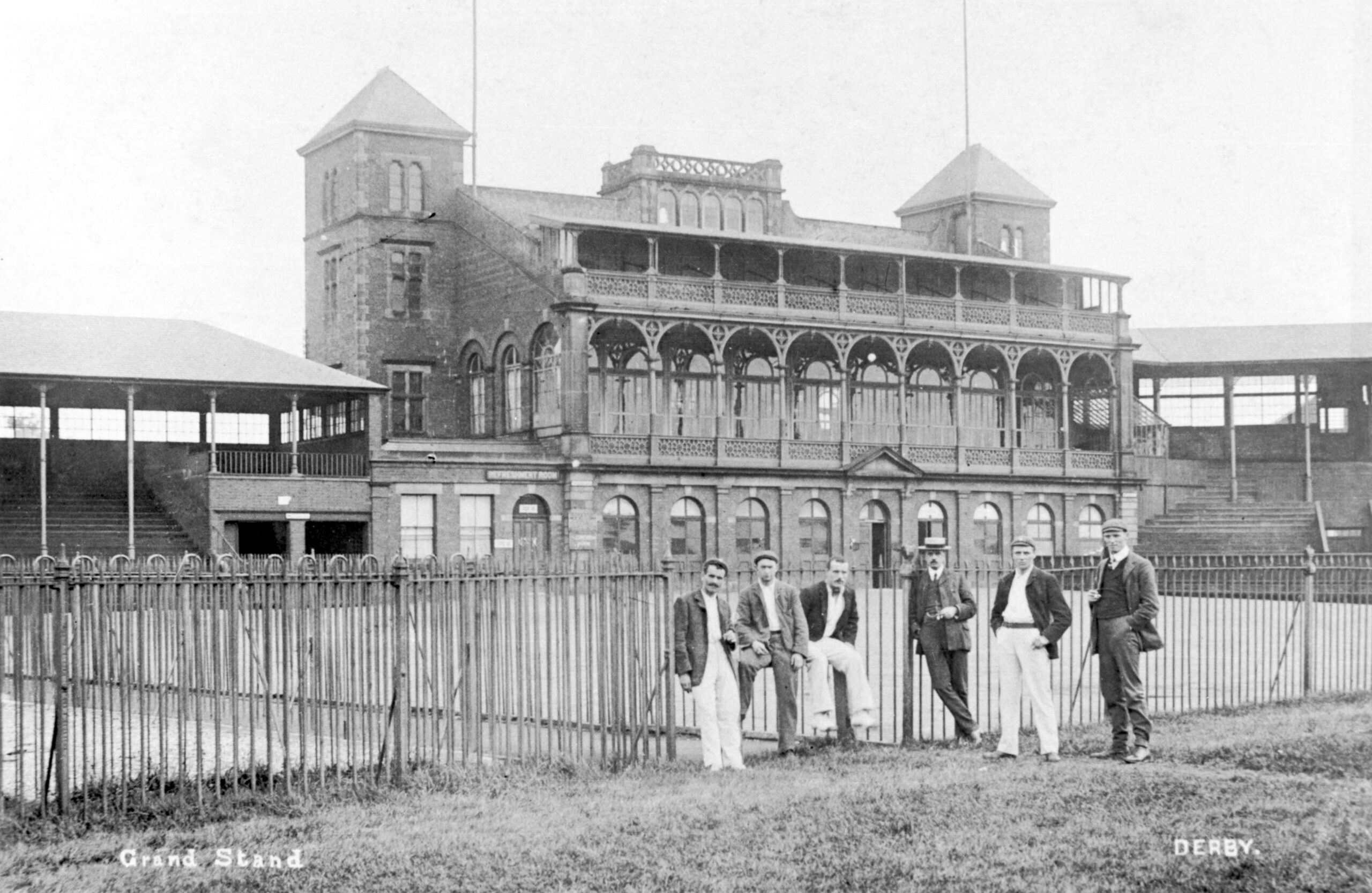
The racecourse had benefitted from the first Grandstand Hotel, erected in 1852 and known as the Duesbury Grandstand after the local architect who designed it.
It was a magnificent structure positioned on the eastern side of the ground where another, subsequent Grandstand Hotel was sited and where The Gateway now stands.
The finishing strait was directly in front of the Grandstand Terrace and could be overlooked by as many as five thousand spectators.
The popularity of horse racing forced the cricket ground to move further to the west of the site as the course needed widening and in 1884 a wooden pavilion was built to house cricketers, members and the press. The cost of around £500 was raised by subscriptions.
The pavilion was positioned close to where the current marquee is with the cricket square some fifty yards to the west of the present one.
As football began to grow in popularity, the formation of Derby County Football Club was heralded as a major coup for the town and they elected to play their fixtures on a pitch to the rear of the cricket pavilion.
Derby County played their earliest Football League fixtures on this ground which was also utilised for an FA Cup Final replay in 1886, several FA Cup semi-finals and in 1895 an international between England and Ireland which the home side won 9-0.
Having been linked via their respective administrations, financial irregularities saw the cricket and football clubs part company in 1891 as the Baseball Ground beckoned for the footballers.
In the meantime, horse racing and Derbyshire cricket continued to co-exist side by side, albeit on different parts of the site.
In 1911, in a remarkable feat of destruction and construction, the Duesbury Grandstand was demolished and the new Grandstand Hotel was built all in the space of five summer months.
A Judge’s Box and Jockey’s Quarters were also established close to where the current pavilion stands. Behind them was The Paddock, an area still used to this day for car parking.
At the start of the 1939 season a new concrete stand was opened. Positioned to the side of the pavilion it was a monstrosity which – because of the subsequent ground move – was only actually used in 1939 and between 1946 and 1954.
By the time the second World War broke out in September 1939, it became apparent that horse racing had no future in Derby.
Several reasons were given for the local authority’s decision, the most interesting of which was that the council felt racing brought too many undesirables to the town.
As the war progressed, the entire racecourse site was utilised by the military with the Grandstand Hotel and Jockey’s Quarters and Stables housing soldiers plus horses. Searchlights were sited on the cricket ground alongside anti-aircraft guns with nearby Rolls Royce an obvious target for German aircraft.
When the war ended in 1945, cricket returned to the fold with a long-term plan – now that racing’s banishment seemed terminal – to move the ground back to the original position. It took a while; it would be ten years before the idea came to fruition.
On the field, Levi Wright became the first cricketer to score five thousand first class runs at Derby. One of the finest of Derbyshire’s late Victorian-era players, Wright’s tally of 5,620 runs remained the most by anyone on the ground until the latter part of the 20th century, while the legendary Bill Bestwick took 399 first class wickets, the most by any bowler.
Bestwick was a wonderful purveyor of fast-medium bowling, a controversial figure responsible for the death of William Brown in Heanor in 1907 but acquitted by an inquest jury which determined that Bestwick had acted in self-defence.
Bestwick’s regular bowling partner, Arnold Warren, played Test cricket for England and forged a formidable pace bowling attack with Bestwick, taking 319 wickets on the ground.
Bestwick took five wickets in an innings a record 27 times, a feat equalled at Derby by both Les Jackson and Tommy Mitchell.
Leg-spinner Mitchell was a member of the 1936 Derbyshire side which won the County Championship. On the Derby pitches which were generally considered to favour quick bowlers, Mitchell took a remarkable 310 first class wickets.
Despite the many successes of those early pacemen at the start of the 20th century, both Ernie Hayes and William Gunn, for Surrey (1904) and Nottinghamshire (1901) respectively, scored 273, still the highest individual scores at Derby.
The highest individual score for Derbyshire was Stan Worthington’s 238 not out in 1937, only eclipsed for the home side as recently as 2022 when Shan Masood made 239.
In 1885 Johnny Briggs took nine for 29 for Lancashire, a record which stood until 1994, while in 1886 George Giffen registered match figures of 16 for 101 for the touring Australians, an analysis which has not been bettered to this day.
There have only been ten instances of bowlers taking nine wickets or more in an innings at Derby with George Davidson the only one to do it twice, for Derbyshire.
He took nine for 42 against Gloucestershire in 1886 and nine for 39 against Warwickshire in 1895. Davidson still holds the Derbyshire individual batting record for the highest score of 274 against Lancashire at Old Trafford in 1896. An outstanding all-round cricketer, he tragically died aged only 32.
Even before these splendid Derbyshire fast bowlers began to ply their trade, Bill Mycroft had been the county’s first champion paceman. His overall record of 863 first class wickets at an average of 12.09 includes 233 at an average of 11.33 at Derby.
A superb left-armer, only four bowlers in the history of the game have taken more first wickets at a lower average than Mycroft.
The highest team score on the ground remains the 661 by Nottinghamshire in 1901 with Derbyshire’s best being 645 against Hampshire in 1898 when four players made hundreds.
Derbyshire’s lowest all out total was 26 against Yorkshire in 1880 while the lowest was Warwickshire’s 28 in 1937.
In that latter game, Bill Copson, fast and very accurate destroyed Warwickshire as the visitors were dismissed in only 98 balls.
He took eight for 11 including a hat trick and four wickets in four balls in the first innings and across the two Warwickshire innings he took five wickets in six balls, six wickets in eleven balls and seven wickets in 18 balls, a feat unmatched at The County Ground.
Behind the wicket, Harry Elliott, another 1936 Championship winner and an England Test cricketer set the early records with 166 catches and 60 stumpings. His overall tally of 226 dismissals at Derby was only overtaken by the peerless Bob Taylor later in the century while those 60 stumpings remain a record.
Attendances were generally good for matches against Lancashire, Warwickshire and Yorkshire, but this was an era when games were played throughout the county with Buxton, Chesterfield and Ilkeston, in particular, hosting a considerable amount of home cricket and thus, although designated as Derbyshire’s headquarters, The County Ground often hosted as little as one third of Derbyshire’s home fixtures.
The largest single day attendance at the ground came in 1948 when the touring Australians, subsequently known as ‘The Invincibles’ arrived with their captain Don Bradman at the helm.
Over 14,000 spectators crammed into the ground, occupying the wooden stands encircling the boundary with – in a sign of post-war prosperity beginning to reveal itself – hundreds of cars parked on the (non-playing) area in front of the Grandstand Terrace. Many youngsters sat on the grass to see Bradman score 62 before being bowled by Derbyshire’s captain, Eddie Gothard. Bradman’s wicket was one of only 18 career victims for Gothard.
As cricket flourished with increased attendances in the post-war period, Derbyshire glanced eastwards across the racecourse to the largely unused facilities in The Grandstand Hotel and the Jockey’s Quarters and drew up plans for a move back to the spot where they had played their earliest cricket matches in the early 1870s.
The second piece in this series will focus on that move and the ground development that followed it, plus a look at the statistical highlights of that period.
Thu 29th October 2026

Thu 29th October 2026
Wed 28th October 2026
Tue 27th October 2026